Marketing with Meaning: A Conversation with Mike Hower @ Hower Impact
Mike Hower found his people—those looking to make a difference while making a living—at a Sustainable Brands conference in San Francisco. He’s turned that realization into a career, first as a journalist covering sustainable business for GreenBiz, TriplePundit, and Sustainable Brands, then as a consultant and climate tech expert, and eventually as the founder of Hower Impact, where he focuses on helping companies close the gap between the sustainability work they’re doing and the stories they’re telling about it through strategic communication and reporting.
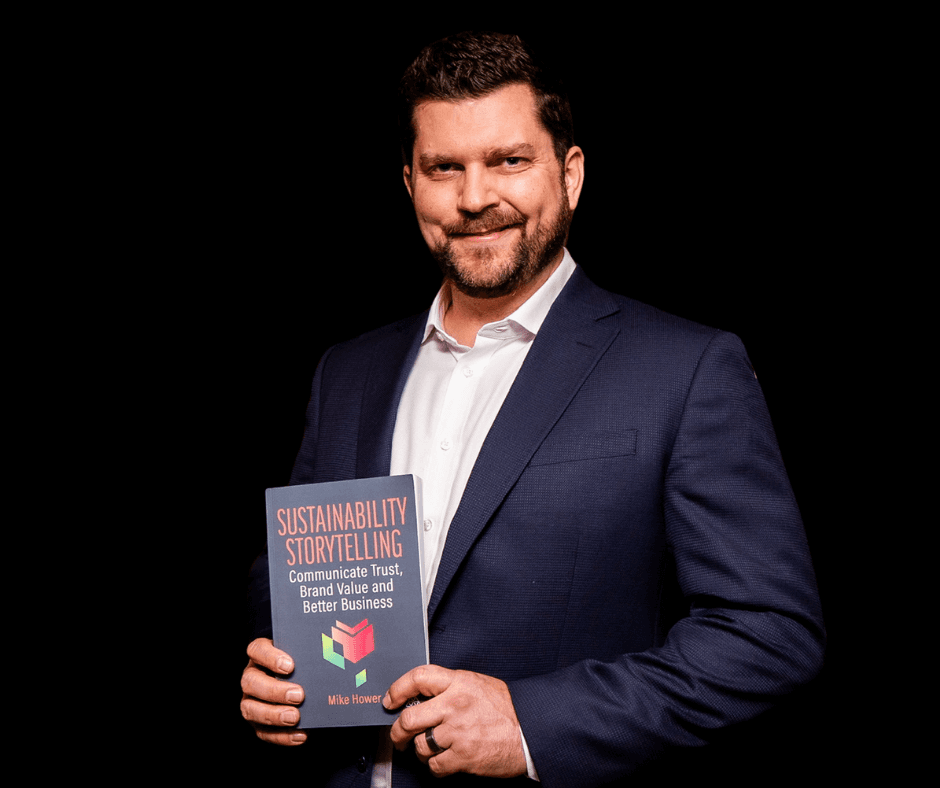
Mike also writes The Sustainability Story on Substack and is the author of the recently published Sustainability Storytelling: Communicate Trust, Brand Value, and Better Business, distilling everything he’s learned across his career to help sustainability, communications, marketing, and legal professionals communicate sustainability more effectively.
In this Marketing with Meaning interview, Mike shares his thoughts about how companies get paralyzed by organizational barriers, the need for early collaboration between communications and legal teams, and why “going green” is a red flag for him.
1. What is the biggest challenge you are focused on solving in your role right now?
Greenhushing. Companies are so worried about offending a single stakeholder—the U.S. federal government—that they’re ignoring the demands of investors, customers, consumers, employees and other stakeholders that want evidence of sustainability action. Silence isn’t a long-term strategy, and the focus on short term survival is undermining companies’ ability to build trust, advance sustainability progress, and ultimately create long-term business value. Most companies are doing the bare minimum, focusing on compliance rather than telling comprehensive, consistent narratives in a strategic way.
2. What’s one thing that’s surprisingly effective at engaging audiences right now, and one thing that brands think works but actually turns people off?
In many ways, sustainability storytelling isn’t all that complicated. It can be narrowed down to one simple action: tell the truth. The problem is, many companies don’t feel comfortable telling the full story—talking about their stumbles and falls. The traditional corporate communications mindset focuses on telling squeaky clean narratives that downplay failures and emphasize successes—and legal often doesn’t want to communicate misses. What’s surprisingly effective is simple: specificity. Not “we’re committed to a better planet“ but “here’s exactly what we changed in our supply chain this year, here’s what it cost us, and here’s how far we still have to go.“ Audiences reward that kind of candor.
What turns people off are purpose monologues. When a brand leads every communication with their mission statement and values before giving you anything concrete, it reads as self-congratulatory. People can smell when a story is about the brand rather than about actual impact. Lead with the impact. Let the values come through organically.
3. How can brands talk about purpose or sustainability in ways that feel real, not performative?
I’ve developed a new framework, shared in my book, that helps companies separate authentic from performative sustainability communication called the Four C’s of Effective Sustainability Storytelling: Context, Compelling, Credible, and Compliant.
Context means understanding the cultural, industry, and reputational forces shaping how your message will land before you’ve said a word. The same story that builds trust in one market can spark backlash in another. Meanwhile, your industry and brand reputation precedes every sustainability message you communicate.
Compelling means making people care enough to act. That’s not about clever copy or creative campaigns—it’s about understanding how people actually make decisions and framing your story in ways that connect to what they already value.
Credible stories are ones where the words align with the actions. It’s not just about having good data—it’s about whether your CEO is actually accountable for this stuff, whether it’s integrated into how the business actually operates, or whether it lives in a sustainability PDF that few read.
Compliant means ensuring your claims can withstand legal and regulatory scrutiny. As greenwashing enforcement accelerates globally, the difference between a well-intentioned claim and a legally problematic one has never mattered more.
The other thing I’d say is stop trying to be the flawless hero. The most effective sustainability stories position the company as an imperfect protagonist solving something hard, not the savior who figured it all out.
4. Please share something you learned about your audience in the last year that completely surprised you or caused you to change your strategy.
I assumed the biggest barrier for sustainability communicators was information—that they needed better metrics or more data. What I actually found, talking to people across industries, is that the problem is largely motivational. Many companies have the data and may even know what they want to communicate. But they’re paralyzed—by legal, by executives who don’t prioritize it, by fear of greenwashing accusations, by not knowing how to translate technical information for non-technical audiences. The challenge is being able to make stakeholders care enough about sustainability information to act on it—whether those are decisions on where to invest, work, or who to buy from. That completely reframed how I think about what help people actually need.
5. What’s one buzzword or trend in marketing you think we should retire? What would you replace it with?
I’d outlaw all of them if I could. An over reliance on buzzwords typically indicates a lack of substance in an organization's sustainability strategy.
But the word "green" particularly peeves me. It has been overused in so much fluffy corporate sustainability communication as to become meaningless. A brand that says it’s “going green“ is a major red flag—as it shows a lack of self-awareness and nuance about what sustainability actually is. The point isn’t to replace it with yet another buzzword, but better messaging that shows rather than tells what your company is doing. If you want to know whether a sustainability story is authentic, ask whether it’s specific. Does it name real places, real people, real numbers, real tradeoffs? Specificity is the actual mechanism behind what we’re trying to describe when we say authentic.
6. How did you end up in your current role? What was the turning point?
The turning point was actually quitting my first corporate PR job in San Francisco to spend a year teaching English in a disadvantaged community in Bogotá, Colombia. I arrived with grand, good intentions and quickly learned how hard it is to address complex social challenges like generational poverty and systemic inequality. What I didn’t realize until years later was that I was unknowingly part of a corporate sustainability case study—the nonprofit I worked for was funded by an IBM corporate social responsibility initiative. But what showed up later as a polished case study in a glossy report PDF, I witnessed as something much messier on the ground. That gap between the stories companies tell about impact and actual impact never left me.
During my year in Latin America, I traveled to Panama’s San Blas Archipelago and talked to Indigenous Guna people about how rising seas were threatening to swallow their island homes. That was the moment climate change became indelibly real for me. I came back to San Francisco knowing I wanted to use storytelling to help address sustainability challenges—I just had no idea how to do that professionally. Upon returning back to the States, I discovered corporate sustainability at my first Sustainable Brands conference—and the rest is history.
7. What skill do you wish you’d developed 10 years ago that would have accelerated your career or made you a more effective communicator?
Legal literacy. Not enough to practice law, but enough to understand how sustainability claims get scrutinized and why. I spent years in journalism and communications thinking legal review was a box to check at the end, not a strategic partner from the beginning. The companies that do sustainability storytelling best have legal and communications sitting at the same table from day one. Learning earlier how to think about claim defensibility would have made me a much sharper advisor, and it’s why I made compliance an entire pillar of my framework.
8. When you’re not thinking about marketing or communications, what inspires your creativity or keeps you grounded?
Traveling the world and experiencing new cultures and different perspectives. Connecting with people all over the world reminds me of our common humanity and that, despite our differences, we are capable of so much more when we work together to solve common challenges.